
Crash Data Recovery
Modern vehicles are far more than mechanical machines — they’re sophisticated computer systems on wheels. Most vehicles manufactured in the last two decades are equipped with an Event Data Recorder (EDR), often referred to as a vehicle’s “black box.” Similar in concept to the flight data recorders used in aviation, an EDR continuously monitors and records critical vehicle data, capturing a snapshot of what was happening in the seconds before, during, and after a collision.
At ADAS Calibration Centre Cairns, our qualified technicians use industry-leading tools to professionally extract, translate, and report on this data. Whether you’re an insurer, legal professional, fleet manager, or law enforcement agency, our crash data recovery service delivers objective, court-admissible evidence that takes the guesswork out of accident investigation.
How Does the Process Work?
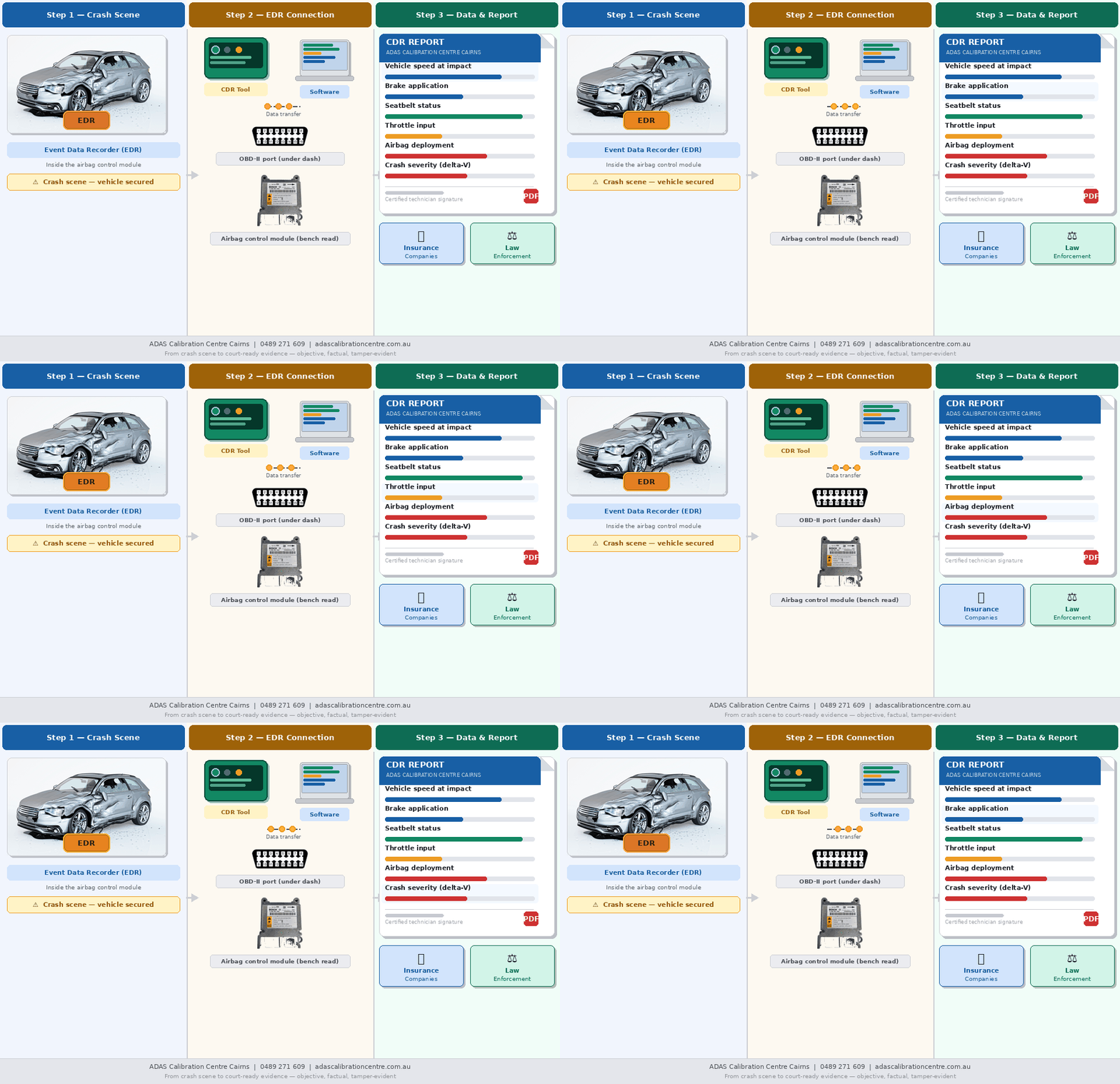
Retrieving crash data is a precise, technical process that requires specialist equipment and trained personnel. Here’s how we do it:
1. Request
2. Vehicle Connection Our technician can connect our special tooling to the vehicle or in some cases (where the vehicle has sustained significant damage) the airbag control module (ACM) may need to be removed and connected directly on the bench.
3. Data Imaging Our tooling creates a digital “image” of the EDR data stored within the vehicle’s control modules. This is a non-invasive, read-only process — nothing is altered or removed from the vehicle during retrieval.
4. Data Translation & Reporting The raw data is translated into a clear, readable format. Our technicians then compile a comprehensive written report, presenting the recovered data in plain language suitable for use by insurance assessors, investigators, legal teams, and courts.
What Information Can Be Recovered?
The volume and type of data recorded will vary depending on the vehicle’s make, model, and year of manufacture, as well as the nature of the crash event.
In general, the recovered data typically includes:
- Vehicle speed in the seconds leading up to and at the moment of impact
- Brake pedal application — whether brakes were applied and to what degree
- Throttle/accelerator input — the level of acceleration prior to the crash
- Steering wheel angle and inputs — directional data at the time of the event
- Engine RPM and throttle position
- Seatbelt status for driver and front passenger — buckled or unbuckled at the time of impact
- Airbag deployment data — which airbags fired, when, and in what sequence
- Crash severity — the magnitude of the impact force (Delta-V)
- Pre-crash vehicle dynamics — including stability control and ABS activation
- Occupant detection — weight sensor data indicating whether seats were occupied
- Number of ignition cycles since the crash event was recorded
- Prior crash events — some modules retain data from previous incidents, which may reveal an undisclosed prior collision
It’s worth noting that EDR data is captured in a matter of seconds — a precise window of time that can paint a detailed, objective picture of the events leading up to, during, and immediately after a collision.
How Insurance Companies Benefit
For insurers, crash data recovery is a powerful tool for assessing claims quickly, accurately, and with confidence. EDR data provides objective, tamper-evident evidence that removes ambiguity from the claims process.
Fraud Detection & Claims Validation EDR data can confirm or contradict a claimant’s account of events. Speed, braking, and throttle inputs at the time of impact can reveal inconsistencies in statements — helping to identify fraudulent or exaggerated claims before they result in costly payouts.
Accurate Assessment of Fault Rather than relying solely on witness statements or physical damage assessments, insurers can use recovered crash data to establish a clear, evidence-based timeline of the crash. This supports fair and defensible liability decisions.
Hidden Prior Damage Detection A CDR report can identify whether a vehicle has been involved in a previous crash event not disclosed at the time of the claim. This is particularly valuable for total loss assessments and repair cost evaluations, where the structural integrity of the vehicle is a key factor.
Personal Injury Claim Support Crash severity data (Delta-V) provides objective insight into the physical forces involved in a collision. This allows insurers to cross-reference claimed injury severity against the actual impact forces recorded — supporting fair settlements and countering exaggerated injury claims.
How Law Enforcement Benefits
For Queensland Police and other law enforcement agencies, EDR data is increasingly being used as a reliable, court-admissible source of evidence in criminal investigations.
Accident Reconstruction Combined with physical evidence from the crash scene, EDR data allows investigators and crash reconstruction experts to build an accurate, evidence-based account of how an incident unfolded. Speed, braking behaviour, and steering inputs can confirm or contradict witness testimony and driver statements.
Criminal Prosecutions EDR evidence has been used in Australian courts to successfully prosecute dangerous and negligent driving offences. In cases involving excessive speed, failure to brake, or other high-risk behaviour, the objective data recovered from a vehicle’s module provides compelling, hard-to-dispute evidence.
Hit and Run Investigations In cases involving hit and run incidents, EDR data — combined with the vehicle’s ADAS sensor logs — can provide additional information about the circumstances of the event, supporting investigators in building their case.
Exoneration Just as EDR data can help secure convictions, it can also exonerate drivers who have been falsely accused. Objective vehicle data ensures that justice is based on facts, not just perception.
Why Choose ADAS Calibration Centre Cairns?
Our team brings together qualified auto electricians, mechanics, and diagnostic specialists with a deep understanding of modern vehicle electronics and ADAS systems. We use the globally trusted standard in crash data retrieval — to ensure data is recovered accurately and reported in a format suitable for legal and insurance purposes.
We work directly with insurers, law firms, fleet operators, smash repairers, and Queensland Police. Our reports are clear, professional, and prepared with the rigour required for formal proceedings.
If you need crash data recovered from a vehicle involved in an accident, contact our team today to discuss your requirements.
